Enterprise Legal AI Architecture
Enterprise architecture supported a personal injury firm through a year of major revenue growth and operational expansion.
A telecom audit exposed a 50% routing drop-off and helped drive answer rates to 98% with a 15-second ASA.
Verified signed-contract data was piped back into ad platforms, lowering CPL by 40%, reducing CAC by 76%, and multiplying ROAS 10x.
Data-backed SOPs, workforce adoption, and automated workflows accelerated the core delivery lifecycle by 68%.
Outcomes are based on anonymized implementation records and executive architecture work inside a personal injury law firm. Client identity, matter records, financial records, contracts, and sensitive operational data are withheld.
Overview
How a personal injury firm turned AI into enterprise operating infrastructure
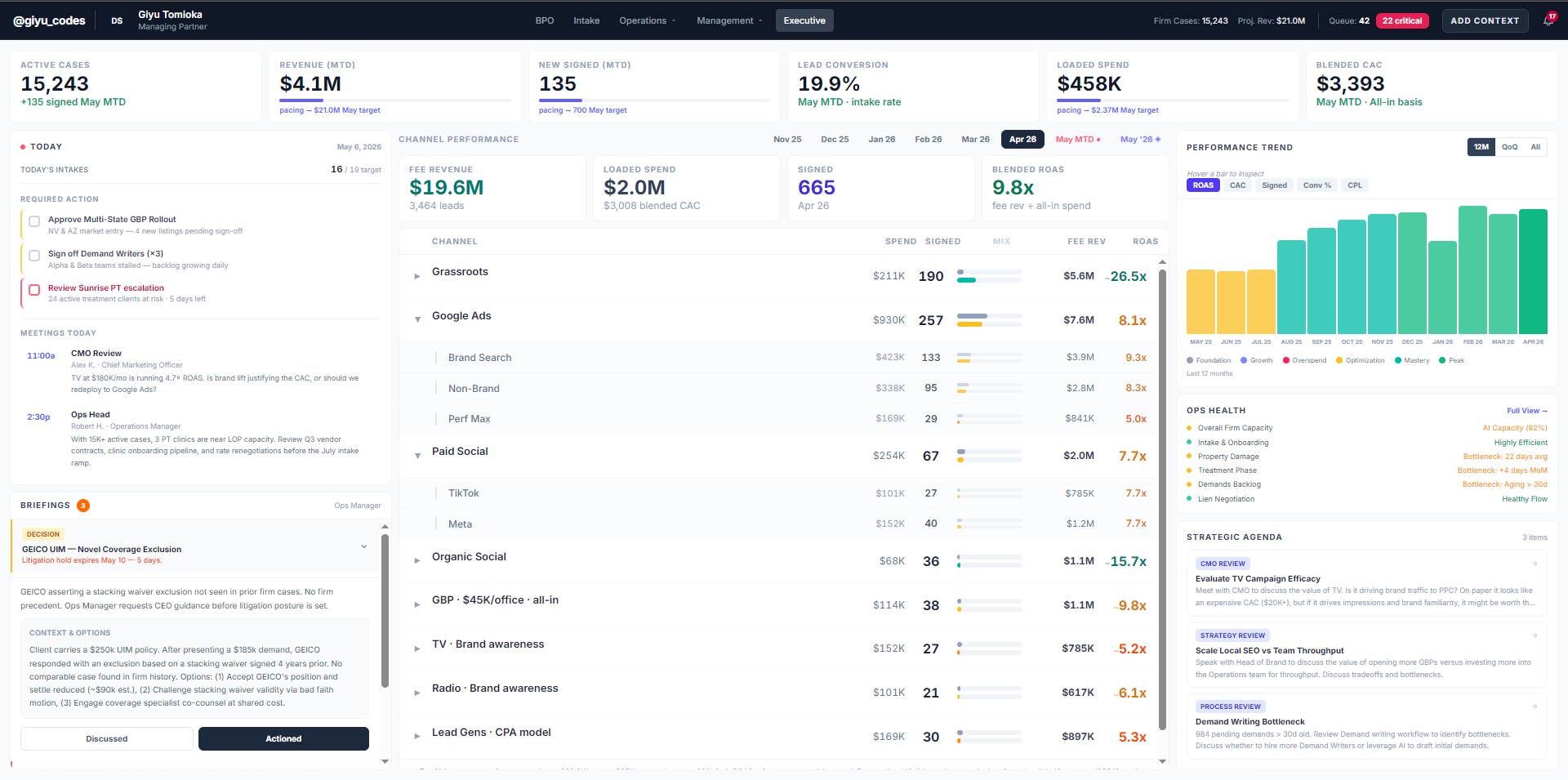
This was not a chatbot project. It was an enterprise architecture transformation inside a high-volume personal injury law firm: marketing, intake, telecom, operations, finance, workforce adoption, and AI workflows brought into one operating system.
The firm scaled from roughly $70M to $250M in annual revenue during the transformation window. The lesson is broader than law: when acquisition costs are high, service delivery is long, and data lives across dozens of tools, AI only works when the underlying architecture becomes disciplined.
| Project context | Public detail |
|---|---|
| Client profile | High-volume personal injury law firm, anonymized under NDA |
| Revenue context | Firm scaled from roughly $70M to $250M in annual revenue during the operating transformation window |
| Enterprise surface area | Marketing attribution, CCaaS, CRMs, intake, operations, finance, workforce adoption, and AI workflows |
| System scale | 15,000+ active cases, 350+ employees during adoption baseline, 10 connected attribution platforms, and thousands of historical calls analyzed |
| Operating thesis | AI should become invisible infrastructure: routing context, surfacing risk, and preparing humans for higher-value decisions |
| Private data | Client identity, matter records, financial records, contracts, call data, and sensitive operational details withheld |
The Failure
Why fragmented AI and SaaS could not carry a nine-figure firm
Leadership initially faced the same temptation many mid-market firms face: build an external AI SaaS product before the internal operating foundation was reliable. The better move was to look inward first.
Ad spend was moving through incomplete attribution. Calls were being lost inside routing logic. Three CRM environments competed for authority. A thousand Zapier automations held together workflows that needed infrastructure, not duct tape.
The hallucinated finance problem
Consumer AI tools were being used as if they were financial engines. In one analysis, a model read only the first rows of a dataset and confidently fabricated an ideal CAC.
Leadership approved additional ad spend from a false conclusion. The lesson became permanent: probabilistic language models cannot be trusted as deterministic finance systems.
The routing truth
A native CCaaS dashboard appeared to show a 98% answer rate. A deeper audit revealed that roughly half of inbound calls never reached the floor because they were trapped before the measured queue.
Once the full funnel was measured, answer-rate strategy changed from dashboard reporting to infrastructure correction.
Architecture
What changed across marketing, intake, operations, and finance?
The architecture was built from the inside out. We advised executives on build-vs-buy decisions, consolidated automation sprawl, migrated core infrastructure, rebuilt attribution, corrected telecom routing, and deployed AI workflows in the background where they could improve decisions without distracting the workforce.
The standard was simple: AI should be quiet. It should route the right context to the right person at the right time, while deterministic systems handle finance, attribution, compliance, and reporting.
Executive Visibility
Dashboards moved from delayed internal correspondence to real-time operating visibility: blended CAC, ROAS, signed-case pacing, active disputes, and meeting-level briefings.
Marketing And RevOps
Verified signed-contract data was piped back into Google Ads, Meta, TikTok, CTV, and other systems so ad spend optimized against revenue, not vanity conversions.
Intake And Telecom
CCaaS migrations from Connex to RingCentral, then RingCentral to Genesys Cloud, helped expose routing failures, lift answer rate from 60% to 98%, and reach a 15-second ASA.
Operations And Churn
Predictive churn systems analyzed calls, texts, CRM data, and case context to flag cancellation risk and route intervention before revenue was lost.
Quality Assurance
Human-in-the-loop review focused people on low-confidence transcripts, multilingual edits, escalations, and SOP updates instead of brute-force manual checking.
Lifecycle Delivery
Document ingestion, case views, routing, and standardized data formats helped compress the core service lifecycle from 250 days to 80 days.
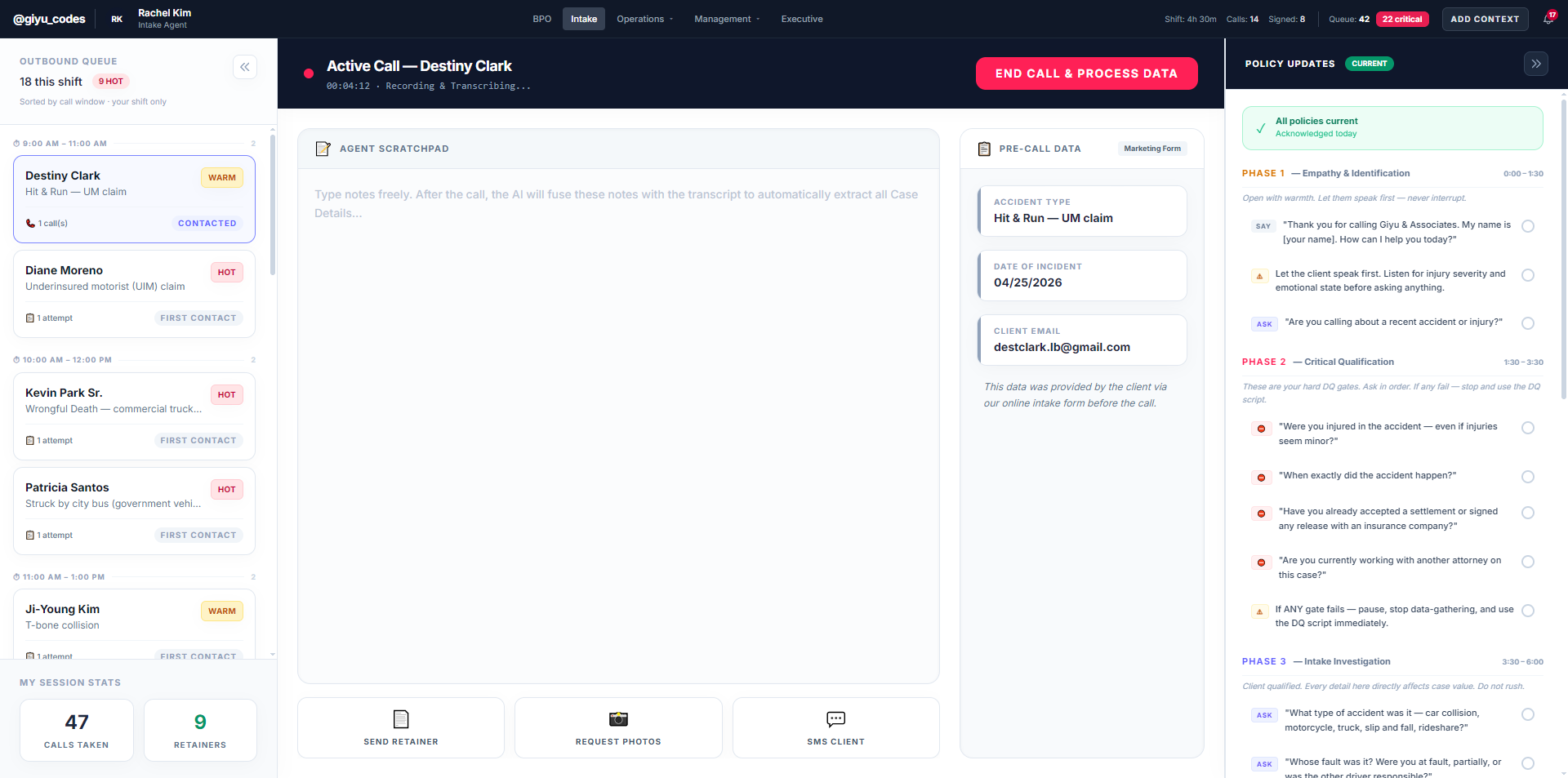
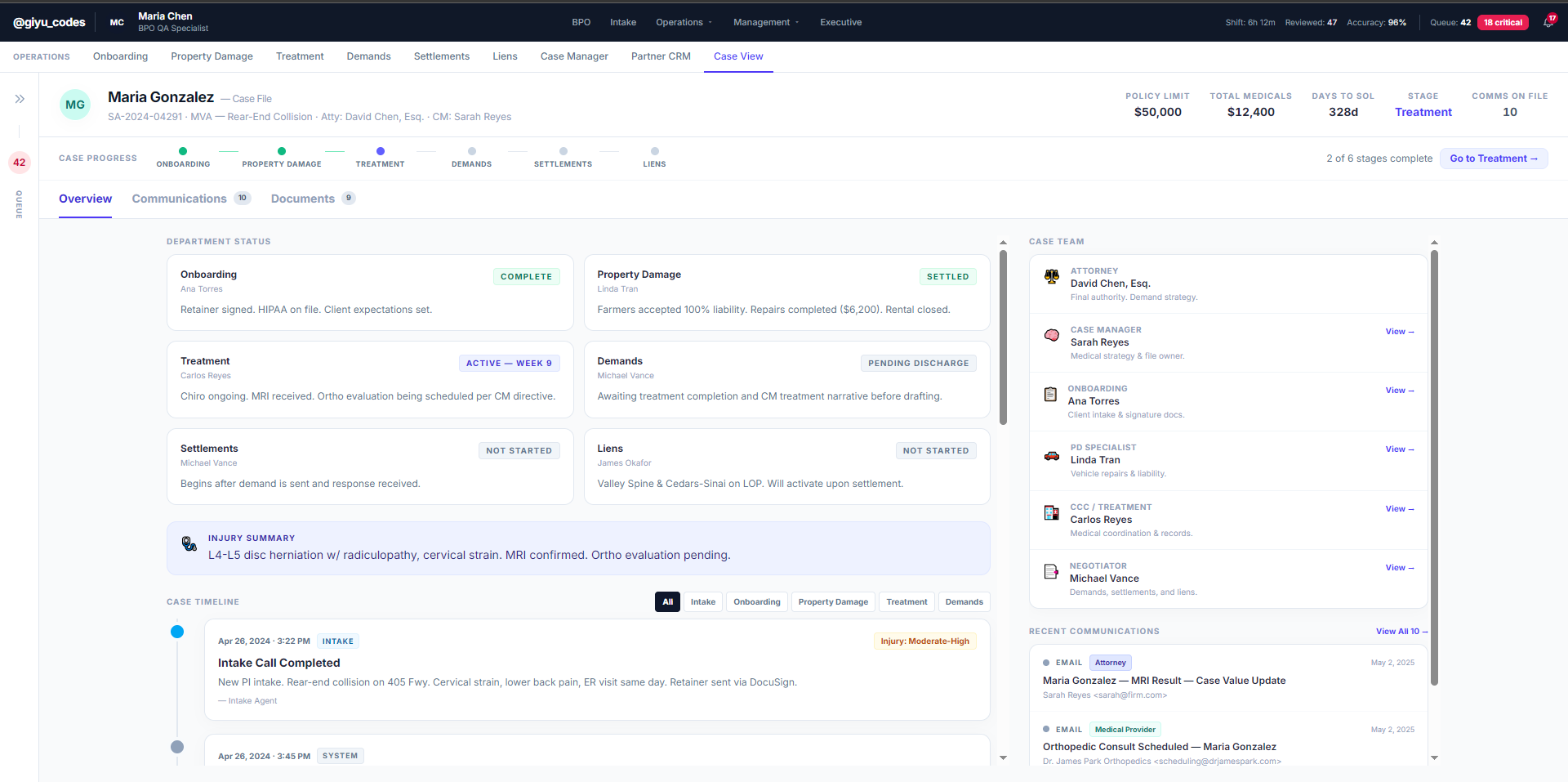
Quiet AI, strict human review
The strongest systems kept AI behind the workflow. Intake agents focused on empathy while AI cleaned, checked, and prepared data after calls. Quality teams reviewed low-confidence segments instead of everything. Managers received escalations when the system found churn-risk, compliance gaps, or SOP drift.
Business Impact
What changed after the firm had an operating intelligence layer?
The transformation was measurable across the whole funnel: marketing, intake, client retention, workflow automation, workforce adoption, and service delivery speed.
Revenue scale supported
$70M to $250M
Implementation work supported a year of major revenue growth while the firm standardized the systems and workflows underneath.
Zapier consolidation
1,000+ to 7
Fragmented automations were collapsed into a smaller, more governable infrastructure pattern while migrating to AWS.
Inbound answer rate
60% to 98%
A telecom audit revealed a 50% IVR/routing drop-off. CCaaS work drove answer rates to 98% with a 15-second ASA.
Average speed of answer
15 sec
Routing, workforce cadence, and CCaaS migrations changed speed-to-lead from a reporting problem into an operating discipline.
Cost per lead
-40%
Attribution cleanup helped the firm reduce CPL while protecting an 8-figure paid acquisition budget.
CAC reduction
-76%
Verified signed-contract data was piped back to Google Ads, Meta, TikTok, CTV, and other platforms.
ROAS expansion
10x
Multi-touch attribution and signed-contract feedback loops changed how marketing spend was allocated.
Intake script length
40 to 15 min
Gemini analysis across thousands of historical calls identified the questions, objections, and talk paths that actually moved conversion.
Client cancellations
-94%
Predictive churn workflows flagged at-risk clients using calls, texts, CRM data, and case context.
Revenue protected
$25M+
Churn-risk intervention protected annual revenue tied to client retention and case continuity.
QA review team
70 to 5
Human review shifted from checking everything manually to reviewing low-confidence intervals, escalations, and exceptions.
Manual hours removed
250,000/year
AI workflows and internal apps eliminated large volumes of manual routing, data entry, review, and coordination.
Adoption
100%
Data-backed SOPs and workforce management enabled measured firm-wide adoption across 350+ employees.
Service lifecycle
250 to 80 days
The core delivery lifecycle accelerated by 68% after operational standardization and workflow support.
The point was not to make AI visible. The point was to remove the friction between problem identification and action. When the full workspace is unified, intelligence extracted at the top of the funnel can shape decisions in the back office.
Citation
How should this case study be cited?
Suggested citation
Meru AI. "Enterprise Legal AI Architecture Case Study: scaling a personal injury law firm with operating intelligence." Meru AI, updated June 2026. https://meruai.co/case-study/legal-ops
What did the legal enterprise architecture improve?
The architecture improved executive visibility, marketing attribution, telecom routing, intake performance, churn prediction, document workflows, and the core legal service lifecycle.
Can this apply outside personal injury law?
Yes. The same operating architecture applies to any mid-market organization with high acquisition cost, call routing, fragmented CRMs, unstructured documents, workforce adoption, and long service lifecycles.
Did the AI replace the workforce?
No. The strongest workflows used AI in the background to prepare context, flag risk, route documents, and reduce clerical work so humans could focus on judgment, empathy, and strategy.
Human Return
The human return
Quiet systems let people do higher-value work.
The lesson is not that every firm needs louder AI. It is that serious operators need architecture that makes the right action obvious before another meeting, spreadsheet, or status request is required.