Sales Intake Intelligence
Average intake and sales conversations became shorter because reps entered calls with context and a clearer question path.
The team improved from baseline conversion after call structure, lead context, and follow-up quality were tightened.
Shorter, better prepared calls helped the team answer more inbound demand without adding headcount.
The system reduced repetitive discovery by separating what the firm already knew from what still needed human judgment.
Outcomes are based on anonymized implementation records from a law firm and professional services sales environment. Client identity, lead records, scripts, and sensitive intake data are withheld.
Overview
How a law firm turned paid demand into prepared sales conversations
A law firm was investing heavily in marketing and handling a constant stream of inbound and outbound conversations. The problem was not simply lead volume. The problem was that expensive demand reached the sales team before the right context did.
This is a common failure pattern for any company with a marketing and sales team. A lead submits a form, clicks an ad, answers an intake question, sends an email, speaks to someone, gets logged in a CRM, and then the next person still starts from zero. Meru built the operating layer that helped reps enter conversations prepared.
| Project context | Public detail |
|---|---|
| Client profile | Law firm and professional services sales operation, anonymized under NDA |
| Engagement length | More than one year of implementation, observation, and refinement |
| Demand profile | High-volume paid marketing and sales intake environment with inbound and outbound call activity |
| Primary bottleneck | Reps entered calls without enough prepared context, then repeated discovery the business already had elsewhere |
| System focus | Call context, question sequencing, CRM visibility, review workflows, and follow-up automation |
| Private data | Client identity, lead records, scripts, recordings, and sensitive intake details withheld |
The Bottleneck
Why more leads were not the answer
Every sales organization wants more qualified conversations. But many teams already have enough context to improve outcomes. It is just trapped across forms, call notes, emails, ad campaigns, CRM fields, prior follow-ups, and manager intuition.
The sales team was not failing because people were lazy or the leads were worthless. They were spending too much of every call rebuilding context the firm had already paid to acquire.
The transferable problem
Before
Long discovery calls repeated known information.
Reps asked too many questions because they lacked a path.
Managers could not see which call patterns led to conversion.
Follow-up depended on memory, stamina, and manual CRM hygiene.
The company was buying demand, then letting that demand leak through operational friction.
Hidden cost
When calls run long, teams miss the next inbound opportunity. When calls start cold, reps waste the first half proving they understand the prospect.
When follow-up is inconsistent, the best marketing campaign in the world still turns into a pile of half-used context.
This is why the system matters for almost every company with marketing and sales: context only creates value when it reaches the conversation in time.
The System
What changed inside the intake and sales motion?
We started by studying the actual sales motion: call recordings, CRM fields, intake data, lead source context, objection patterns, and the moments where the best reps stopped qualifying and started guiding.
The goal was not to replace the salesperson. The goal was to remove the cold start from every conversation, reduce repeated discovery, and make the best call path easier for the whole team to follow.
What the system changed
Reps entered the call with context.
Lead source, form answers, prior notes, and relevant CRM history were surfaced before the conversation, not reconstructed during it.
Discovery became a shorter decision path.
The system separated what was already known from what still needed to be asked, reducing the call from interrogation to guided qualification.
Managers could inspect the sales motion.
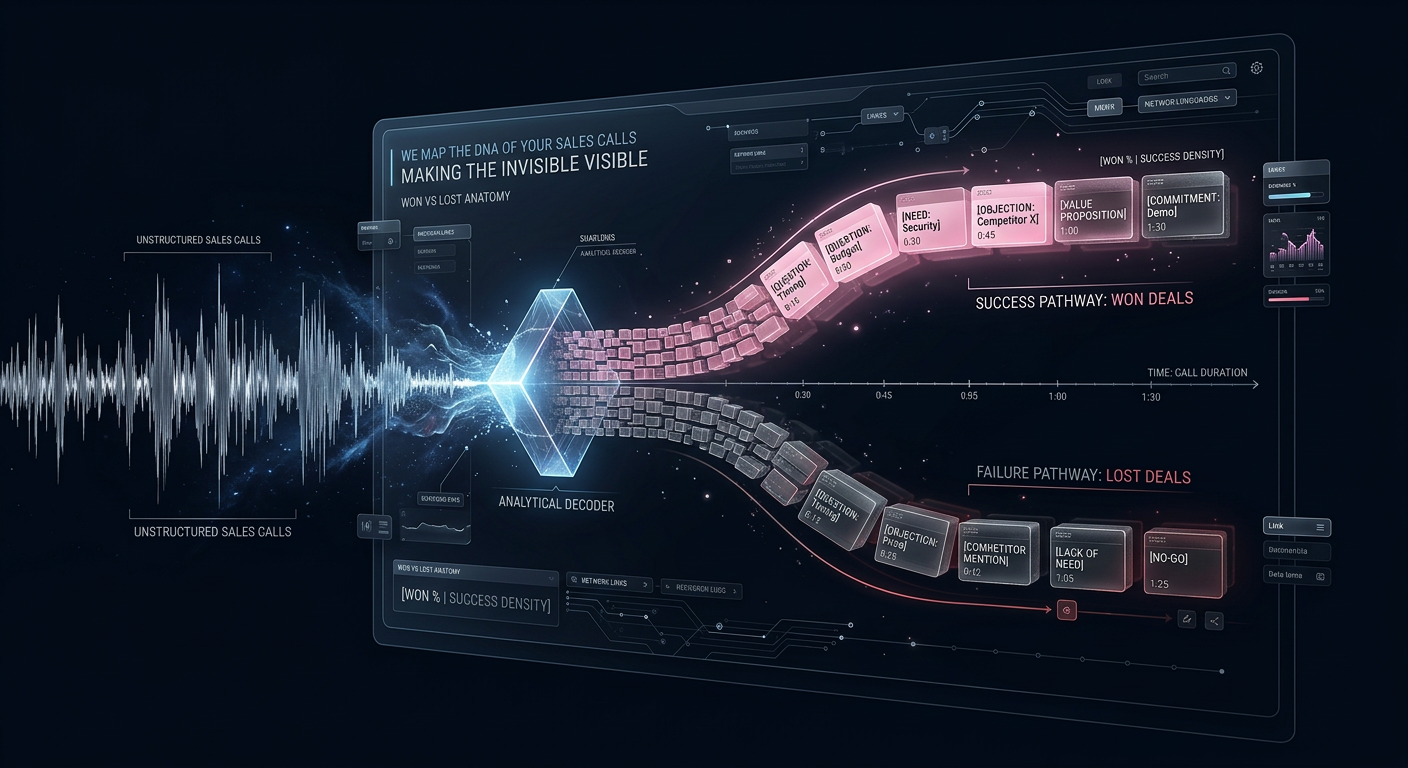
Calls became reviewable patterns: questions asked, objections raised, next steps missed, and follow-up quality after the conversation.
Conversation intelligence layer
We structured the unstructured parts of the sales motion: what questions were asked, what context was available, where calls stalled, which objections appeared, and which follow-ups were needed after the call.
Implementation layers
Lead Context Brief
Before the conversation, reps saw the intake context, source signal, known facts, and likely qualification gaps.
Question Path
The team moved from long scripted discovery to a smaller set of questions tied to the decision that actually needed to be made.
Manager Visibility
Calls became easier to review for missed context, repeated friction, unanswered objections, and coaching opportunities.
Follow-Up Automation
The system helped prepare next steps, reminders, and message drafts so good conversations did not die after the call.
Business Impact
What improved after the system was adopted?
The value came from turning the existing sales motion into a clearer operating system. Calls became shorter, more context-aware, and easier to follow up.
Before and after
40 to 15 min
Average discovery and intake conversation length
9% to 14%
Consult conversion from baseline to improved sales motion
90 to 120/day
Calls answered per day as average call duration fell
Business value
The system improved capacity without asking the team to become more robotic. It gave reps a better starting point, managers a clearer review loop, and the business a stronger connection between marketing spend and sales execution.
This is why the case study matters beyond one law firm. Any organization buying demand can lose revenue when the sales team starts every conversation without the context the company already collected.
The lesson is practical: before replacing your sales team with AI, make sure your current team has the context, sequence, and follow-up system needed to turn demand into revenue.
Citation
How should this case study be cited?
Suggested citation
Meru AI. "AI Sales Intake Case Study: turning paid demand into prepared conversations." Meru AI, updated June 2026. https://meruai.co/case-study/sales-optimization
What problem did this sales intake system solve?
The system reduced repeated discovery by surfacing lead context, organizing call questions, improving review workflows, and supporting follow-up after the call.
Was this only useful because the client was a law firm?
No. Law firms make the problem easy to see because intake quality matters so much, but the same pattern applies to any company with paid demand, CRM records, sales calls, and follow-up requirements.
Did the system replace sales reps?
No. It made reps more prepared. Humans still owned persuasion, judgment, relationship handling, and the decision to move a prospect forward.
Human Return
The human return
Your sales team may already have the answer.
The missing piece is often not more leads, more scripts, or a new AI agent. It is a system that carries the right context into the moment where a human conversation can actually change the outcome.